


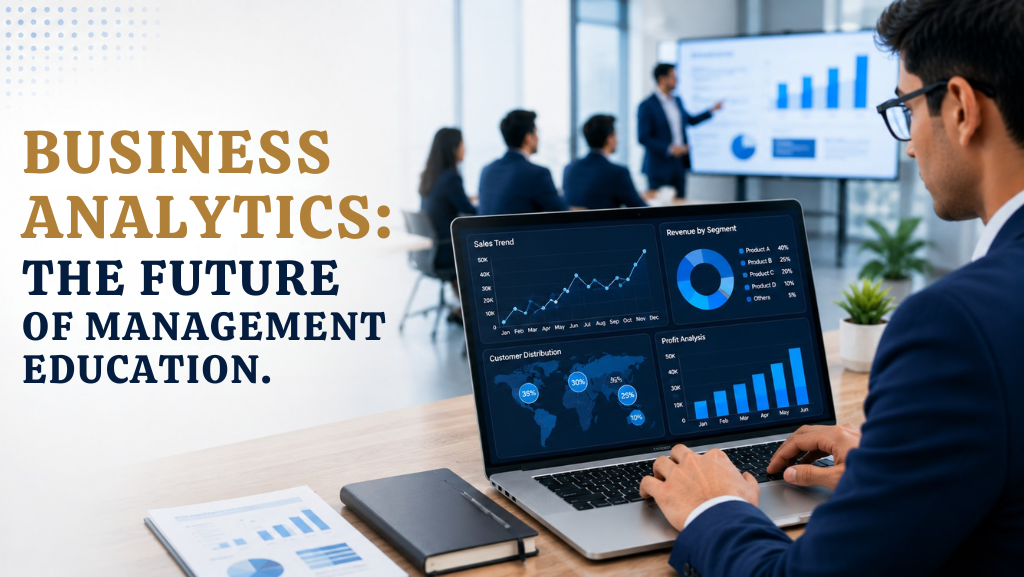
The business landscape is changing rapidly, and data has become one of the most valuable resources for organizations. Companies now rely on facts and insights rather than assumptions to make important decisions. This growing dependence on data has increased the demand for professionals who can analyze information and turn it into meaningful strategies. As a result, Business Analytics has become an essential part of modern management education, preparing students to succeed in a technology-driven business world.
What is Business Analytics?
Business Analytics is the process of collecting, organizing, analyzing, and interpreting data to support better business decisions. It combines business knowledge with analytical techniques and digital tools to identify trends, solve problems, and improve organizational performance. Whether it is understanding customer preferences, forecasting sales, or optimizing operations, Business Analytics helps organizations make informed decisions that lead to sustainable growth.
Why Business Analytics is Transforming Management Education
Traditional management education focused primarily on subjects such as marketing, finance, human resources, and operations. While these subjects continue to be essential, modern businesses expect managers to analyze data and apply insights to make effective decisions.Modern management programs now integrate analytics, data visualization, business intelligence, and predictive analysis into their curriculum, enabling students to develop practical decision-making skills.
This shift allows students to think critically, evaluate business situations objectively, and create solutions based on reliable information. It also prepares them to work confidently in industries where technology and data play a central role.
Benefits of Learning Business Analytics
Improved Decision-Making
Business Analytics enables future managers to make informed decisions using accurate data instead of relying solely on intuition. This approach reduces uncertainty, minimizes risks, and supports long-term business success.
Strong Analytical and Problem-Solving Skills
Students learn to interpret business data, identify patterns, and recommend practical solutions to real-world challenges. These skills enhance logical thinking and prepare graduates to handle complex business situations effectively.
Better Career Opportunities
The demand for analytics professionals continues to grow across industries such as banking, healthcare, retail, manufacturing, information technology, and e-commerce. Graduates with analytical expertise can pursue careers as Business Analysts, Data Analysts, Financial Analysts, Operations Analysts, Market Research Analysts, and Business Intelligence Professionals.
Exposure to Industry-Relevant Tools
Management students are introduced to widely used tools such as Microsoft Excel, Power BI, Tableau, SQL, and Python. Learning these technologies helps students develop practical skills that employers actively seek in today’s competitive job market.
The Importance of Practical Learning
Business Analytics is most effective when supported by practical experience. Case studies, internships, live projects, workshops, and industry interactions help students understand how businesses apply analytics to solve real challenges. This hands-on learning approach bridges the gap between classroom knowledge and workplace expectations, making graduates more confident and job-ready.
Preparing Students for the Future
Emerging technologies such as artificial intelligence, machine learning, automation, and cloud computing continue to reshape industries around the world. These technologies depend heavily on data, making analytical skills more valuable than ever. Students who develop a strong foundation in Business Analytics are better prepared to adapt to changing business environments, lead innovation, and contribute to organizational growth throughout their careers.
Conclusion
As organizations continue to embrace digital transformation, the ability to understand and use data has become a defining skill for successful managers. Business Analytics strengthens decision-making and problem-solving skills while preparing students to confidently manage challenges in today’s competitive, data-driven business world. Investing in analytical knowledge today creates opportunities for long-term career growth tomorrow.
For students looking for quality Management Education in Hubli, choosing an institution that offers strong academics along with practical industry exposure is a valuable step toward a successful career. Global College of Management, IT & Commerce provides industry-focused education that equips students with the knowledge, skills, and confidence needed to build rewarding careers in the modern business world.
Recent Posts
-
How to Build a Portfolio Using College Projects, Certifications and Practical Assignments
-
Why Industry-Oriented BBA Programs Are Becoming Popular Among Students
-
Why B.Com is Still One of the Most Preferred Degree Courses After 12th
-
Financial Management Concepts Every BBA Student Must Master
-
GST and Digital Tax Systems: Unlocking Career Opportunities for B. Com Graduates