


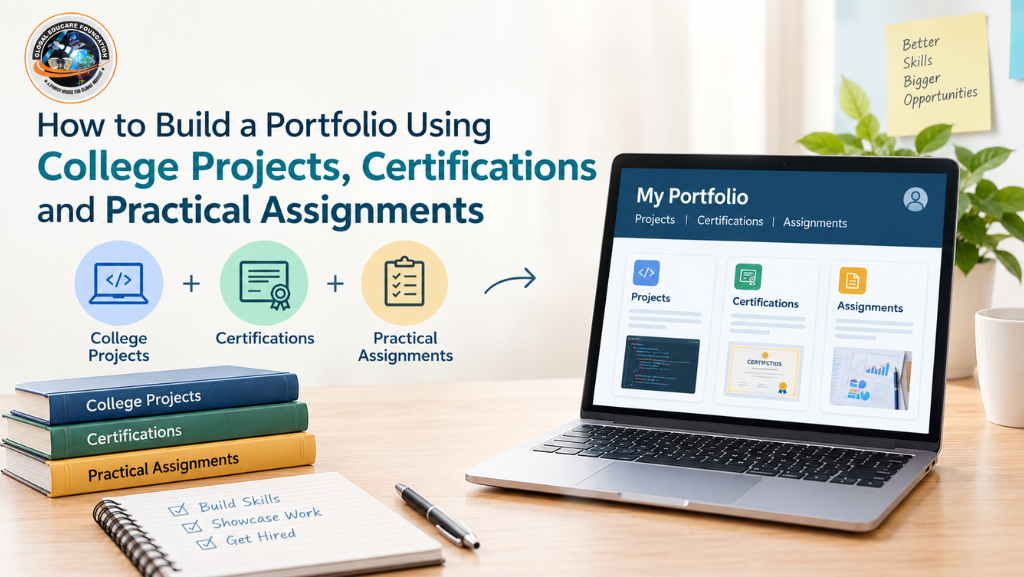
A college education provides students with theoretical knowledge, but employers also want to understand how well they can apply that knowledge in practical situations. A portfolio helps students showcase their abilities, projects, certifications and achievements in one place. It provides evidence of their learning and gives potential employers a better understanding of their skills.
Whether you are studying BCA, BBA, B.Com or PUC, building a portfolio during your academic journey can help you prepare for internships, job opportunities and higher education. Here are some practical ways to create a portfolio that reflects your knowledge and potential.
1. Identify Your Career Goals
Before creating your portfolio, think about your interests and future career plans. Your goals will help you decide which projects, certifications and assignments to include.
For example, a BCA student interested in software development can focus on coding and website projects. A BBA student can showcase business plans and marketing research, while a B.Com student can include accounting exercises and financial reports.
Choosing relevant work helps you build a portfolio that matches your career interests.
2. Showcase Your College Projects
College projects are an excellent starting point because they demonstrate how you apply classroom learning to practical tasks. Select projects that highlight your knowledge, creativity and problem-solving abilities.
Here are some examples for different academic streams:
- BCA: Website development, database management, programming applications and software projects.
- BBA: Business proposals, market research, customer surveys and marketing strategies.
- B.Com: Financial analysis, accounting reports, budgeting exercises and taxation assignments.
- PUC: Research assignments, subject-based projects, presentations and practical experiments.
For each project, explain its objective, your responsibilities, the tools you used and the results you achieved. If you completed the project as part of a team, clearly describe your individual contribution.
3. Include Relevant Certifications
Certifications can help you develop additional skills beyond your regular syllabus. They reflect your interest in gaining new skills and expanding your expertise in your chosen field.
Students can consider certifications in Excel, programming, digital marketing, graphic design, financial accounting, data analytics and business communication.
Choose courses that match your interests and provide useful knowledge. Include the certification name, issuing organisation and completion date in your portfolio. You can also provide a verification link when available.
Instead of collecting certificates without a clear purpose, focus on learning skills that you can apply to projects and assignments.
4. Add Practical Assignments and Case Studies
Practical assignments demonstrate how you use your knowledge to complete tasks and solve problems. They can make your portfolio valuable even if you have not yet completed an internship.
For example, a BCA student can develop a simple website, a BBA student can prepare a business plan, and a B.Com student can create a sample financial report. Students can also include presentations, research findings and case studies completed during college.
Explain the problem you addressed, the steps you followed and what you learned from the experience. Use original work and avoid including confidential information.
5. Create a Professional Digital Portfolio
A digital portfolio makes your work easy to access and share with recruiters, teachers and potential employers. You can create one using Google Sites, GitHub, Behance or a well-organised PDF document, depending on your field.
Keep your portfolio simple, organised and professional. Include the following sections:
- About Me
- Education
- Projects and Assignments
- Certifications
- Technical and Communication Skills
- Achievements
- Contact Information
Use clear headings, readable text and relevant screenshots or project links. Check that all links work correctly before sharing your portfolio.
6. Highlight Your Skills with Real Examples
A portfolio should show more than a list of skills. It should provide examples that demonstrate what you can do.
For instance, if you mention teamwork, describe how you contributed to a group project. If you highlight communication skills, include a presentation or report you prepared. Students can also showcase leadership experience gained through college events, competitions and volunteering activities.
Providing evidence of your abilities makes your portfolio more meaningful and helps others understand your strengths.
7. Update Your Portfolio Regularly
Your portfolio should grow as you gain new knowledge and experience. Review it every few months and add new projects, certifications, assignments and achievements.
Ask teachers, mentors or classmates to review your work and suggest improvements. Correct spelling mistakes, improve project descriptions and remove outdated information.
Before applying for an internship or job, adjust your portfolio to highlight the projects and skills most relevant to the opportunity. This makes it easier for recruiters to understand your suitability for the role.
Conclusion
Building a portfolio during college helps students demonstrate their knowledge, practical abilities and achievements through real examples. By combining college projects, relevant certifications and practical assignments, students can showcase their problem-solving skills, creativity and readiness for professional challenges. Regularly updating the portfolio with new learning experiences also helps students track their progress and prepare confidently for internships, job interviews and higher education opportunities.
Students looking to strengthen their practical knowledge can explore skill development courses in Hubli to gain industry-relevant skills alongside their academic studies. Choosing the best college in Hubli can also support academic growth, practical learning and career preparation. Explore Global College of Management, IT & Commerce to discover learning opportunities that help students enhance their skills and prepare for successful careers.
Recent Posts
-
How to Build a Portfolio Using College Projects, Certifications and Practical Assignments
-
Why Industry-Oriented BBA Programs Are Becoming Popular Among Students
-
Why B.Com is Still One of the Most Preferred Degree Courses After 12th
-
Financial Management Concepts Every BBA Student Must Master
-
GST and Digital Tax Systems: Unlocking Career Opportunities for B. Com Graduates